 Back to Tips
Ponta da Ferraria and Mosteiros: São Miguel's west tip, the hot sea pool, the lighthouse and Escalvado
 Azores Guide
The Ferraria road reopened in May 2026 under traffic lights after the 2025 landslide, and the paid spa has closed for good. How to time the free hot sea pool with the tide, the PRC43SMI cinder-cone loop, the 1901 lighthouse, the Escalvado whaling lookout and the Mosteiros sunset.
The west tip of São Miguel is a short drive from Ponta Delgada and easy to pair with Sete Cidades. Most visitors come for one thing, the hot spring at Ponta da Ferraria that runs into the sea. The road down to it was shut for eight months after a landslide in September 2025, and the spa above the pool has since closed for good. This guide covers what is open in autumn 2026, how to time the pool, and what else is on the short stretch of coast between Ferraria and Mosteiros: a lighthouse, a cinder-cone walk, a whaling lookout and the island's best sunset.
Getting there
From Ponta Delgada to Ponta da Ferraria is about 25 km by car, a good half hour, through Relva and Ginetes. From Ferraria the coast road runs north to the Ponta do Escalvado viewpoint, about 4 km and under ten minutes, and on to Mosteiros, another 4 km. From Mosteiros you can climb to Sete Cidades village, about 11 km and a quarter of an hour, which makes a loop of the whole west end.
The times are for a clear road. The last stretch down to the Ferraria pool is slow, for the reason below.
Ponta da Ferraria after the landslide
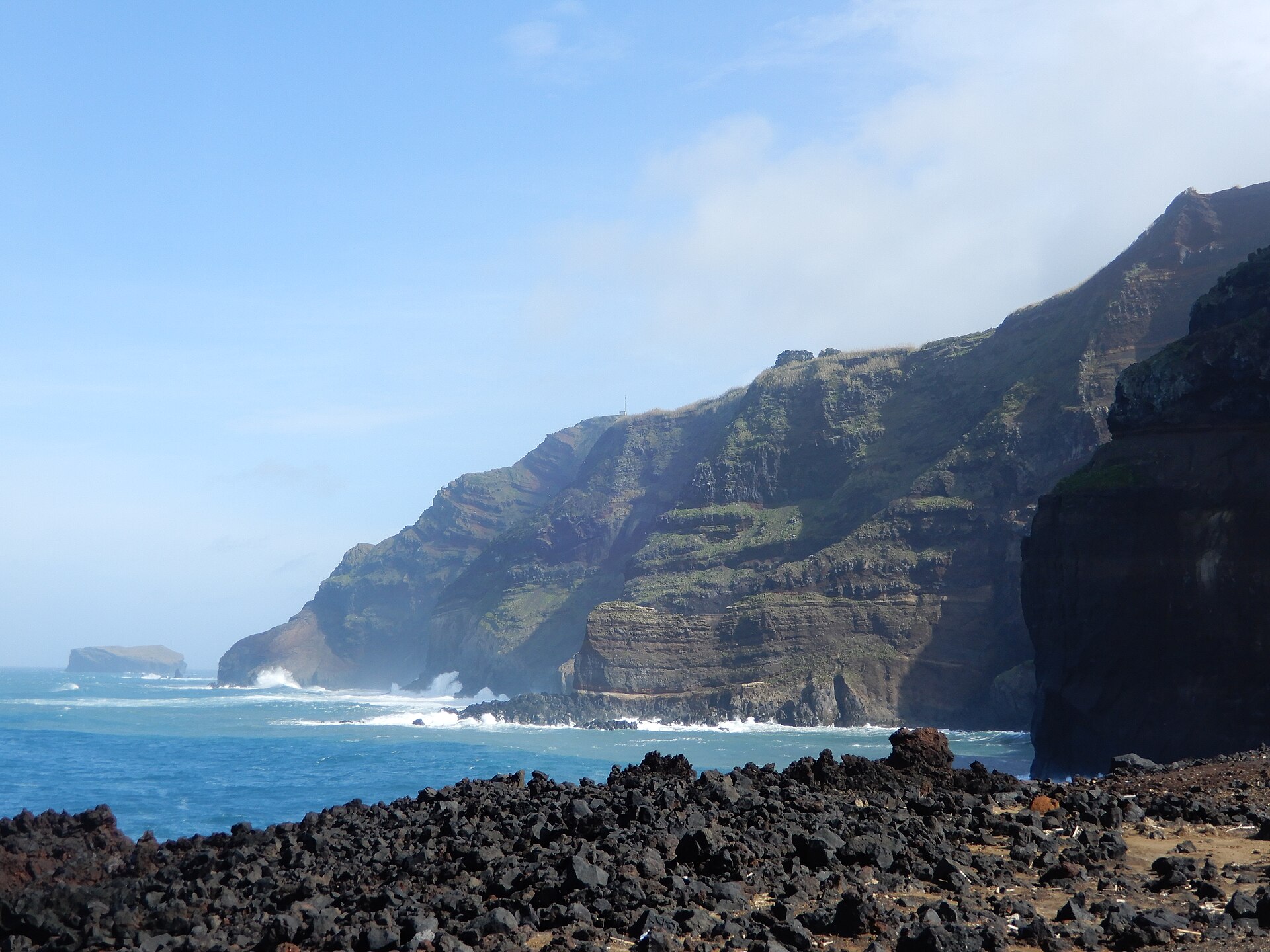
Ponta da Ferraria is a low lava platform at the foot of a high cliff, reached by a single road that zigzags down the cliff face. On 15 September 2025 a landslide brought earth and large boulders down onto that road. Nobody was hurt, but the authorities closed it the same afternoon.
The road reopened to cars on 20 May 2026, with conditions. Crews built about 30 metres of concrete-block wall along the worst stretch. Traffic lights now let cars through one direction at a time, in the lane farthest from the slope. The regional government said geotechnical studies were under way for permanent stabilisation work planned for the winter. That work may close the road again, so check the latest news before you set off.
The Termas da Ferraria, the paid spa building with its own thermal pools above the sea, did not survive the closure. Its operator, Palco Natural, said it could not carry on without customers, and in April 2026 the spa closed for good after 16 years. The regional government said it would put the concession out to a new tender. Old guides that quote spa prices and opening days are out of date.
The hot sea pool
The free pool below is a different thing from the spa, and it still draws people. Hot water rises through the lava at the foot of the cliff and mixes with the sea in a rocky inlet. Ropes run across it to hold on to. You get in by steps and a ladder.
The tide decides everything. Around low water the inlet is mostly spring water and properly hot: the official trail page puts it above 30 °C. As the tide rises, the Atlantic takes over and the water cools. Aim for about an hour either side of low tide, and look up a tide table for Ponta Delgada before you drive out.
Two more rules:
- When there is a swell, the waves come straight into the inlet. Stay out, whatever the tide.
- The supervised bathing season at Ferraria in 2026 ran from 1 June to 30 September. Outside it there is no lifeguard.
Pico das Camarinhas and the Ferraria cliff (PRC43SMI)
If you would rather walk down than drive, the official trail PRC43SMI makes a loop of 3.6 km, graded easy, with about two and a half hours given for it. It starts and finishes by the Ilha Sabrina viewpoint at the top of the cliff and drops from about 215 m almost to sea level.
The first part climbs a dirt track up Pico das Camarinhas, a cinder cone. From the top you see three craters in a line from west to east, the mark of a fissure eruption, with Ponta da Ferraria and Ginetes below. The path then drops past a lava dome to the foot of the cliff and follows it past sea arches and a crater blown out by steam to the hot pool. Take a swimsuit and time the walk so you reach the pool near low tide. On 19 October 2026 the trail was not on the official list of closed routes.
The viewpoint at the start is named after a lost island. On 10 June 1811 an eruption began on the sea floor off Ponta da Ferraria and built a cone that grew to 90 or 100 m high. The commander of the British sloop HMS Sabrina, James Tillard, landed on it on 4 July and claimed it for Britain. The waves had taken it apart by October, and the claim went with it.
Ferraria lighthouse
The Farol da Ferraria stands on the cliff above the point, at the western end of the island, with road access. It was first lit in November 1901: an 18 m stone tower on the front of a two-storey keeper's house. It shows three white flashes every 20 seconds, from 107 m above the sea.
The lighthouse opens to visitors once a week, on Wednesday afternoons. The regional tourism listing gave 14:00 to 17:00 as the summer hours in 2026, with groups of eight or more needing permission from the harbour authority. Winter hours were not published, so check before you plan around it. On the other six days you can still look at it from outside.
Miradouro da Ponta do Escalvado
North of Ferraria the coast road runs along the top of the cliffs to the Ponta do Escalvado viewpoint. It sits inside a small protected area of the Parque Natural de São Miguel. The little building at the edge is an old whaling lookout.
The view is north along the coast to the lava delta of Mosteiros and its islets. The light is best in the late afternoon. The car park by the road is small, so park with care when it is full.
Escalvado is also on Visit Azores' Cumeeiras/Litoral Noroeste mountain-bike route: 39 km from the lake shore at Sete Cidades, with over 1,400 m of climbing, past the lighthouse, Escalvado and Pico do Mafra. It is graded black for fitness.
Mosteiros
Mosteiros is a fishing village on a lava delta at the north-west corner of the island. Four rocky islets stand about 900 m offshore, the highest 72 m above the sea. They are what is left of an undersea volcanic cone worn down by the waves. The chronicler Gaspar Frutuoso wrote that the first settlers thought the largest looked like a church or monastery, and the village took its name from them: mosteiros means monasteries.
There is a black-sand beach in the village and, at its south end, natural pools in the lava with a café on the sea wall. The supervised season for both in 2026 ran from 15 June to 13 September. On a rough day swim in the pools, not off the beach. Mosteiros faces west, which almost nowhere else on São Miguel does, so people come for the sunset, in the water or on the rocks. Our beaches guide compares it with the other bathing spots on the island.
From above, the Lomba do Vasco viewpoint looks down on the village. You can reach it as a detour from the PR03SMI walk along the Sete Cidades crater rim.
How to plan the day
- Morning: Sete Cidades and the crater rim while the cloud is still high. Our Sete Cidades guide covers parking and fog.
- Midday or afternoon: Ponta da Ferraria at low tide, either down the road or on the PRC43SMI loop.
- Late afternoon: Escalvado, then Mosteiros for the sunset.
Low tide moves by about 50 minutes a day, so build the day around it and fit the rest in. A Wednesday adds the lighthouse.
Quick answers
Is the road to Ponta da Ferraria open? It reopened to cars on 20 May 2026, single file under traffic lights, after the September 2025 landslide. Permanent works were planned for the winter, so check before you go.
Are the Termas da Ferraria open? No. The paid spa closed for good in April 2026. The natural hot sea pool below is free and still used.
When is the Ferraria pool warm? Around low tide, when spring water outweighs the sea. Go within about an hour of low water, and stay out when there is a swell.
Can you visit the Ferraria lighthouse? On Wednesday afternoons. The 2026 summer hours were 14:00 to 17:00; check the winter hours before you go.
Sources
- Ferraria: road reopened with conditions after risk-mitigation works, Jornal Açores 9, 20 May 2026
- Ferraria landslide: access road still closed, RTP Açores, 16 September 2025
- Termas da Ferraria close for good after 16 years, Açoriano Oriental, 28 April 2026
- PRC43SMI Pico das Camarinhas - Ponta da Ferraria, Trails Azores
- Trail alerts, Trails Azores
- Portaria n.º 204-A/2026/1, bathing seasons 2026 (Diário da República supplement)
- Farol da Ponta da Ferraria, Visit Azores tourism listing
- Lighthouses of Portugal: Azores, Lighthouse Directory
- Ponta do Escalvado, Parques Naturais dos Açores
- Cumeeiras/Litoral Noroeste bike route, Visit Azores
- Sabrina Island, Wikipedia
- Mosteiros Islets, Wikipedia
Azores Guide
Author
More Travel Tips

The priolo on São Miguel: the Priolo Centre, the Tronqueira forest and where to see the Azores bullfinch
The Azores bullfinch lives only in the laurel forest behind Nordeste. The Priolo Centre's 2026 season and hours, its guided tours from €40, how to look for the bird yourself, the Pico da Vara permit, and what to do with a grounded shearwater in October and November.

Capelas, São Miguel: Morro das Capelas, the sea pools and the north-west coast
Twelve kilometres north of Ponta Delgada and far quieter than Sete Cidades: a submarine volcano that joined the island, the Poços sea pool and its 2026 bathing season, a teacher's workshop museum, an easy coastal trail and the viewpoints west towards Bretanha.

São Miguel in winter: weather, hot pools, short days and what stays open
São Miguel from November to March: mild but wet, with December the wettest month and sunset at about 17:26 on the shortest day. Terra Nostra and Poça da Dona Beija stay open all winter, the Ponta Delgada museum keeps winter hours, whale boats still sail, the Lagoa do Fogo road is open to cars again, and the beaches have no lifeguards.